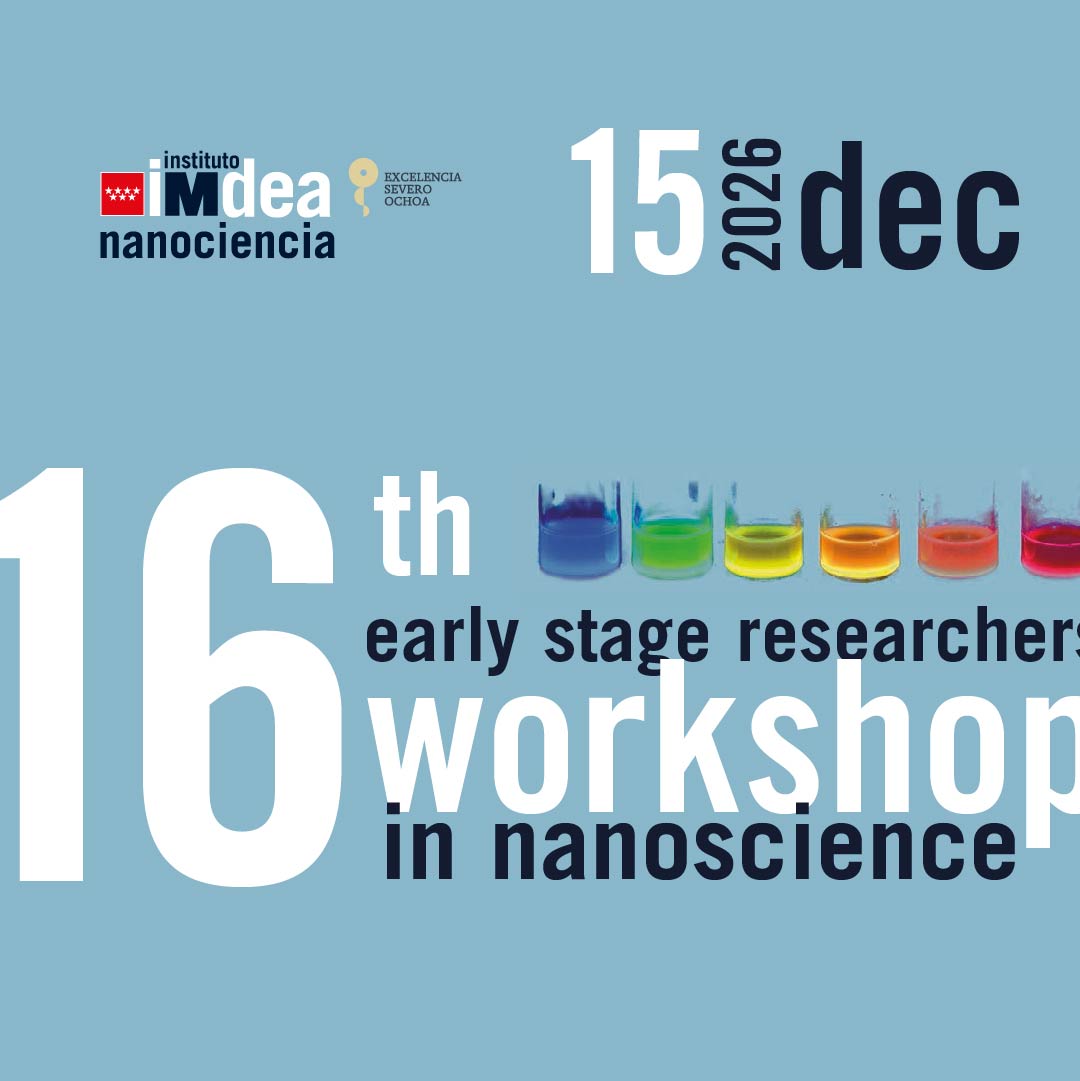

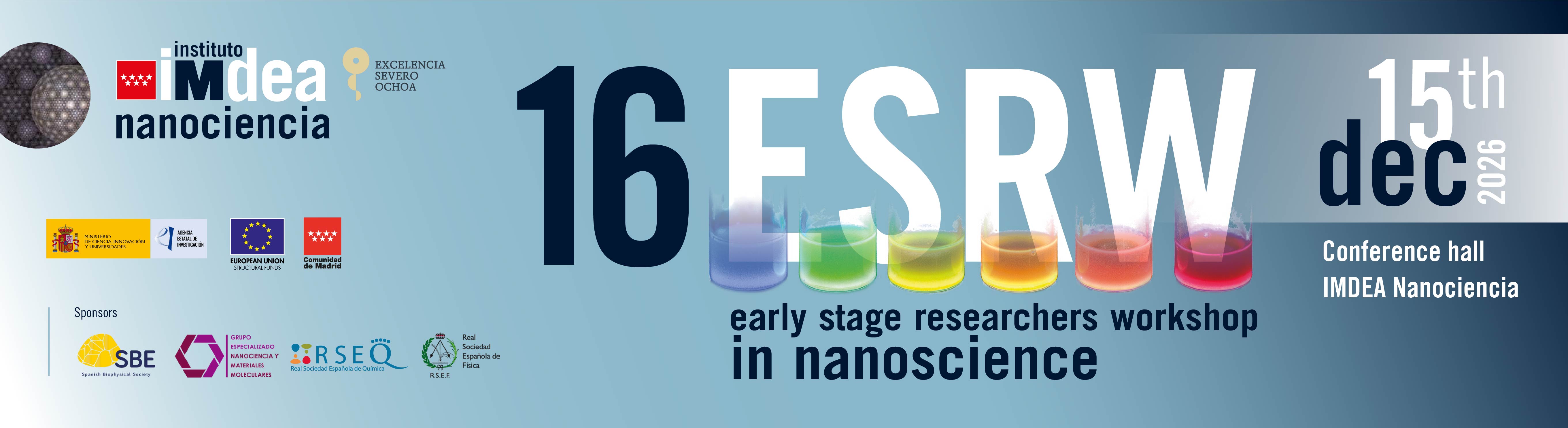
16th Early Stage Researchers Workshop in Nanoscience
-
15th December 2026
IMDEA Nanociencia conference hallInvited speakers:
*Click on the names to expand and see the abstracts and biographies.Dr. Ferry Prins (IFIMAC)
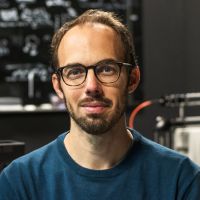
Super-resolution optical microscopy in materials science: resolving ultrafast dynamics in nanostructured semiconductors
Keynote talk
AbstractNanostructured Semiconductors are playing an increasingly dominant role in next-generation light-harvesting and light-emitting applications. In these materials, quantum confinement effects allow for enhanced control over their optoelectronic properties, while reduced processing temperatures provide routes to more flexible integration. However, the reduced dimensionality and increased disorder can significantly impact the spatial dynamics of the energy carriers within the material. To study these effects, we employ Transient Photoluminescence Microscopy techniques, which allow for a direct visualization of the excited-state transport with few-nanometer and sub-nanosecond resolution. In this talk, I will highlight some of our recent efforts using this super-resolution technique, with an emphasis on perovskite semiconductors of varying compositions and dimensionality. I will start the talk by giving an overview of some of the surprising effects that can be observed in these materials, particularly regarding the relationship between lattice softness and the exciton transport properties. In the last part of the talk, I will present our most recent efforts using interferometric scattering techniques to study perovskite semiconductors. The exceedingly high signal-to-noise ratio that interferometric scattering provides allows not only for the direct imaging of charge carriers, but also for super-resolution imaging of lattice dynamics.
Biography
Ferry obtained an MSc in Chemistry from Leiden University (2007) and a PhD in Physics from Delft University of Technology (2011). After completing his PhD, he joined the group of Prof. Will Tisdale at the Massachusetts Institute of Technology (MIT). There, he started exploring the optical properties of nanomaterial assemblies with an emphasis on excitonic energy-transfer interactions. With support from the Swiss National Science Foundation, he started his own group in 2015 at the Optical Materials Engineering Laboratory at ETH Zurich. Since Spring 2017, he has been a member of the Condensed Matter Physics Center (IFIMAC) at the Autonoma University of Madrid where he directs the Photonic Nanomaterials and Devices Lab. His group focuses on the development of new microscopy techniques to improve our understanding of nanoscale energy transport.
Dr. Celia Castillo Blas (ICMM-CSIC)
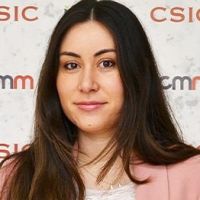
Metal-organic frameworks beyond crystallinity
Keynote talk
AbstractMetal–organic frameworks (MOFs) are traditionally designed and understood through their crystalline structures. However, loss of long-range order does not necessarily imply loss of chemical or structural complexity. Amorphous MOFs, melt-quenched MOF glasses and MOF-based glass composites provide an emerging platform in which local coordination motifs can be retained while long-range periodicity is removed, opening new possibilities for processing, interfaces and functionality.
In this contribution, I will discuss our recent work exploring MOFs beyond crystallinity, from controlled amorphisation to melting and glass formation. Particular attention will be given to how linker chemistry, metal coordination and framework topology determine access to the liquid state, and how these parameters may ultimately enable a more predictive design of meltable hybrid frameworks. I will also introduce strategies in which MOF glasses are combined with inorganic glasses to create structurally complex composites and hierarchical amorphous materials, where interfaces and selective post-processing generate functionality that cannot be achieved from either component alone.
Together, these results highlight disorder not as the endpoint of framework degradation, but as a new structural degree of freedom. Understanding and controlling local and medium-range order may therefore provide a route towards a broader family of processable hybrid glasses and composites with tunable structural, mechanical and functional properties.
Biography
Dr Celia Castillo-Blas is an Atraccion de Talento Fellow at the Institute of Materials Science of Madrid (ICMM-CSIC), where she develops an independent research line on structurally disordered porous and hybrid materials. She obtained her PhD at ICMM-CSIC and subsequently carried out postdoctoral research at the Autonomous University of Madrid and the University of Cambridge, including a visiting period at the University of Jena. Her research combines reticular chemistry with advanced structural characterisation, with particular emphasis on defects, amorphisation, melting and glass formation in metal–organic frameworks and related hybrid materials. She makes extensive use of synchrotron and neutron total scattering, Pair Distribution Function analysis and spectroscopy to understand structure beyond crystallinity. In 2026, she was awarded an ERC Starting Grant to develop predictive approaches for the design of functional hybrid glasses.
The 16ESRW workshop is sponsored by


-
The 16th edition of the Early Stage Researchers Workshop in Nanoscience (16ESRW) will take place on 15 December 2026 at the conference hall of IMDEA Nanociencia. This annual meeting brings together early stage researchers from different fields of nanoscience, offering an opportunity to present their research, exchange ideas, discover new approaches and connect with fellow researchers.
The workshop is open to PhD students and postdocs, who are invited to present their work through oral or poster communications. The poster session will run alongside the oral presentations, with all posters on display at IMDEA Nanociencia ground floor from 9:00 to 17:00 h.
There will also be prizes recognising the outstanding contributions, for Best Oral Communication and Best Poster Communication, as well as special mentions for Best Question and Best Social Media Communication. The prizes will be presented during the closing remarks, thanks to the support of our workshop sponsors.
Everyone is welcome to attend, and registration is free. Registration is required, so please follow the steps provided in the “Registration” tab.
Throughout the meeting, we will explore the wide range of research currently being carried out in nanoscience and hear about the latest results from different research groups. Nanoscience brings together many disciplines, including physics, chemistry and biology, making ESRW a particularly diverse meeting. We therefore encourage all presenters to make their contributions accessible to an audience from different scientific backgrounds.
The Early Stage Researchers Workshop ESRW was first held in June 2011 with the aim of bringing together early-stage researchers in the field of Nanoscience, to discuss their research, broaden their knowledge, and create opportunities for networking. Since 2011, the Workshop has been held annually at IMDEA Nanociencia, with a wide participation of over 90 researchers from various institutions, presenting their works with oral and poster contributions.
Come, share your science and learn from others at 16ESRW!
The 16ESRW workshop is sponsored by
-
Scientific committee
Dr. Natalia Martín
Dr. Vasileios Balos
Dr. Alberto Martín
Dr. Patricia PedrazDr. Rebeca Bocanegra
Dr. Mario MartínezOrganising committee
Dr. Manuela GarnicaDr. Valle PalomoDr. José Ángel SilvaDr. Sara HernándezDr. Ignacio UrgelDr. Elena AlonsoLaura Ortega -
Registration is mandatory for all attendees.
Call for abstracts
Abstract submission: deadline 3rd of November 2026.Registration: deadline 30th of November 2026.Steps to submit your abstract:
1. Download the abstract template.
2. Fill it and convert it to PDF. The maximum file size is 10 MB, reduce images size if necessary.
3. Upload it along your registration form (button above).
*Applicants submitting an abstract are required to sign in to Google to upload their documents. In case this is not feasible for you, please contact the organising committee.Abstract template - The use of template is mandatory. The abstract should not exceed one page.

Template Selection process
Sixteen abstracts will be selected by the Scientific and Organizing Committee for oral presentations. The remaining contributions will be invited to be presented as posters. When registering, please indicate whether you would prefer to present your work as an oral or poster contribution. While we will do our best to accommodate your preference, the final selection of oral presentations will be made by the Scientific and Organizing Committee.
Preparing your contribution
Once you receive confirmation of your contribution, you can start preparing your talk or poster.
Oral presentations will be 12 minutes long + 3 minutes for questions.
Posters should be prepared in A0 vertical format (84.1 x 118.9 cm). All posters will be displayed in the ground-floor corridors of IMDEA Nanociencia throughout the day of the event.
-
The workshop will be held at the Conference Room of IMDEA Nanociencia.
Postal address: C/ Faraday, 9
Campus de Cantoblanco
28049 Madrid
SpainContact the Organising Committee by email at: This email address is being protected from spambots. You need JavaScript enabled to view it.
How to arrive to IMDEA Nanociencia:
From Madrid (city centre)
- By train (Cercanías)
- Line C4 (Alcobendas-San Sebastián de Los Reyes/Colmenar Viejo), stop at “Cantoblanco Universidad” + 15 min. walk.
- By bus
- Only from “Plaza de Castilla” bus station. Line 714, stop at “Newton-Fco. Tomás y Valiente” + 3 min. walk.
“Plaza de Castilla” is connected to metro lines 1, 9 and 10.From the airport Adolfo-Suárez/Barajas
- By train (Cercanías)
- Line C1 till “Chamartin” station and change to line C4 (Alcobendas-San Sebastián de Los Reyes/Colmenar Viejo), stop at “Cantoblanco Universidad” + 15 min. walk.
- By bus
- Only from Terminal 4. Line 827, stop at “Newton-Fco. Tomás y Valiente” + 3 min. walk. There is a free shuttle bus that connects all terminals of the airport.
By taxi
- Taxi call centre: +34 91 547 8200, +34 91 371 2131.
- From the airport a flat fare of 30€ applies.
-
The #ESRWnano Social Media Scientific Session is an online event with the purpose of encouraging the participants of the Workshop in the communication of their results using social media platforms, expanding their network and fostering creativity.
The Social Media Sci Session will be held on the 15 December 2026.
The posts published until 15:00 h will opt to the prize.How to participate
- Share a post of your research or creativity related to your science. The format is free. Examples: animated posters, reels, TikTok videos, photography with your poster, etc. Make sure your post is public and others can discover it.
- Use the hashtag #ESRWnano and the handle of IMDEA Nanociencia in your post. The IMDEA Nanociencia social media accounts are: /company/IMDEA-nanociencia (LinkedIn), @imdeananociencia.bsky.social (Bluesky), @IMDEA_Nano (X), @imdeananociencia (Instagram, TikTok), This email address is being protected from spambots. You need JavaScript enabled to view it..


- Discuss and answer the questions from the community. We encourage you to engage in scientific debate by commenting on other posts and sharing research ideas.
IMDEA Nanociencia will be reposting the communications in the feed below, in order for everyone to follow the discussion online. If you notice your post has not been reposted here, or you are posting in a social network where IMDEA Nanociencia does not have an official account, please write the committee at This email address is being protected from spambots. You need JavaScript enabled to view it..
The Best Social Media Communication will be decided by the scientific committee, according to the a) scientific content (40%), b) creativity (50%) and c) interactivity (replies, likes and impressions, 10%).
The best post will be awarded with a prize during the closing session
↓ Your #ESRWnano post will be reposted in this wall ↓